OpenAI vs Anthropic vs xAI Explained: The AI Companies Shaping the Future
Quick Summary
Over the last few years, AI has become one of the fastest-growing industries in the world,…

Over the last few years, AI has become one of the fastest-growing industries in the world, transforming everything from content writing and coding to research, automation, and online search. While most people recognize AI chatbots like ChatGPT, Claude, or Grok, very few actually understand the companies behind them and how they are competing to shape the future of technology.
Today, three companies are leading the global AI race — OpenAI, Anthropic, and xAI. Although all three are building advanced AI systems, their goals, philosophies, and strategies are very different. Some are focused on making AI accessible to everyone, while others prioritize safety, reasoning, or real-time internet intelligence.
Understanding the difference between these companies is important because they are not just creating chatbots — they are building the infrastructure that could define the future of the internet itself.

Best Tech Gadgets for Desk Setup in 2026: Smart Accessories That Improve Everyday Work
Read StoryAI Companies vs AI Chatbots: What’s the Difference?
One of the biggest misconceptions in the AI industry is that people often confuse AI companies with AI chatbots. For example, many users think OpenAI and ChatGPT are the same thing, but they are not.
OpenAI is the company, while ChatGPT is one of its products. Similarly, Anthropic created Claude, and xAI developed Grok.
In simple terms, these companies build the AI models and technologies, while the chatbots are the tools that everyday users interact with.
This distinction matters because the real competition in the AI industry is happening between the companies themselves — not just their chatbots.
How OpenAI Became the Face of the AI Revolution
When people talk about modern AI, OpenAI is usually the first name that comes up. Founded in 2015 by major tech figures including Sam Altman and Elon Musk, OpenAI originally started as a research-focused organization with the mission of developing safe and beneficial Artificial General Intelligence (AGI).
However, the company’s global breakthrough came after the launch of ChatGPT. Within months, ChatGPT became one of the fastest-growing consumer applications in history and introduced millions of people to generative AI for the first time.
OpenAI’s influence extends far beyond chatbots. The company is also developing AI systems for image generation, coding assistance, voice interaction, and video generation. Its partnership with Microsoft has provided massive financial support and computing infrastructure, helping OpenAI scale its AI models much faster than many competitors.
Today, OpenAI is widely considered the dominant force in consumer AI because it successfully transformed AI from a niche technology into a mainstream digital tool used by students, businesses, creators, and developers worldwide.
Why Anthropic Is Taking a Different Approach to AI
Unlike OpenAI, Anthropic was founded with a stronger emphasis on AI safety and alignment. The company was created by former OpenAI researchers who believed that future AI systems could become extremely powerful and therefore needed stronger safeguards and responsible development practices.
This philosophy became the foundation of Anthropic’s strategy. Its AI assistant, Claude, is designed to prioritize safer interactions, deeper reasoning, and more reliable long-form understanding. Because of this, Claude has gained popularity among developers, researchers, and enterprise users who need AI systems capable of handling large documents and complex instructions.
Anthropic’s approach is often seen as more cautious and research-oriented compared to OpenAI’s aggressive consumer expansion. Instead of focusing primarily on mass adoption, the company is investing heavily in trustworthy AI systems that businesses and organizations can rely on over the long term.
As AI becomes more integrated into professional and enterprise environments, many experts believe Anthropic could become one of the most influential companies in the next phase of the AI industry.
xAI and Elon Musk’s Vision for AI
The AI industry became even more competitive when Elon Musk launched xAI. Musk was already deeply connected to the AI world because he was one of OpenAI’s original co-founders before leaving the company years later.
With xAI, Musk introduced a different philosophy centered around building what he describes as a “truth-seeking AI.” The company’s chatbot, Grok, was designed to provide more real-time and internet-connected responses compared to many traditional AI assistants.
One of xAI’s biggest advantages is its integration with the X platform (formerly Twitter). This gives Grok access to live discussions, trends, and real-time information, allowing it to position itself differently from competitors that rely more heavily on static training data.
xAI has also attracted attention because of Musk’s broader ecosystem, which includes companies like Tesla, SpaceX, and X. Many analysts believe this ecosystem could eventually give xAI unique advantages in areas such as robotics, social platforms, and real-time AI systems.
Although xAI entered the AI race later than OpenAI and Anthropic, the company has already become one of the fastest-rising names in the industry.
What These AI Companies Have in Common
Despite their differences, OpenAI, Anthropic, and xAI share several similarities. All three companies are building large language models and advanced generative AI systems capable of understanding and generating human-like responses.
They are also competing in similar areas such as coding assistance, research automation, reasoning systems, and digital productivity tools. Training these AI systems requires enormous amounts of computing power, data infrastructure, and financial investment, which is why the AI industry has become one of the most expensive technology sectors in the world.
Another major similarity is their interest in Artificial General Intelligence, or AGI. AGI refers to AI systems capable of performing a wide range of intellectual tasks at a human-like level. While true AGI does not exist yet, companies like OpenAI, Anthropic, and xAI are all racing toward that future in different ways.
OpenAI vs Anthropic vs xAI: Who Is Leading the AI Race?
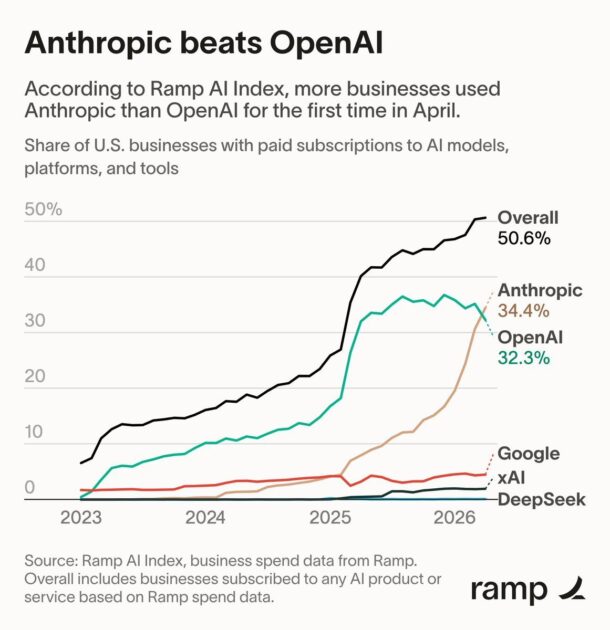
At the moment, OpenAI remains the most recognizable AI company globally, largely because of ChatGPT’s massive popularity. The company has successfully dominated the consumer AI market and continues to expand rapidly.
However, Anthropic is growing quickly in the enterprise and professional AI space. Many businesses and developers are increasingly turning to Claude for tasks involving long documents, detailed reasoning, and reliable responses.
Meanwhile, xAI is positioning itself as a real-time, internet-connected alternative powered by Elon Musk’s ecosystem and influence. Its integration with X gives it a unique identity in the AI landscape.
Rather than following the exact same strategy, these companies are building different versions of the future. OpenAI is focused on large-scale consumer adoption, Anthropic is emphasizing safety and reliability, and xAI is pushing real-time and socially integrated AI systems.
The Future of the AI Industry
The future of AI will likely extend far beyond chatbots. Companies like OpenAI, Anthropic, and xAI are expected to influence industries such as healthcare, education, robotics, software development, media, and online search.
OpenAI appears focused on becoming the dominant consumer AI platform. Anthropic is building trusted AI systems for enterprise and professional use, while xAI is attempting to merge AI with real-time internet culture and Elon Musk’s broader technology ecosystem.
As competition intensifies, the AI industry is beginning to resemble the early days of the smartphone revolution, where multiple companies competed not just on technology, but on vision, ecosystem, and long-term influence.
Final Thoughts on OpenAI, Anthropic, and xAI
The competition between OpenAI, Anthropic, and xAI is becoming one of the biggest technology battles in the world. While all three companies are building advanced AI systems, their goals and strategies are very different. OpenAI is leading the mainstream AI market through ChatGPT, Anthropic is focusing on safe and reliable AI with Claude, and xAI is trying to create a more real-time and internet-connected AI experience through Grok.
As AI continues to grow, these companies could become as powerful and influential as today’s biggest tech giants. The future of AI will not only depend on who builds the smartest chatbot, but also on which company creates the most trusted, useful, and widely adopted AI ecosystem.
Share this article
Related Articles
Continue reading similar stories.
Trending Now
Popular articles readers are exploring.

Xiaomi 17 Pro Review – The New Flagship Evolution
Lenovo Legion Pro 7i Review 2026 – The Ultimate Gaming & Creator Laptop

Vivo X200 FE Full Review in 2026: Price, Camera, Features & Performance

iPhone 17 Air Full Review: Price, Camera, Battery & Features