
Artificial intelligence development has reached a point where incremental improvements no longer excite the tech community. The real attention is now on strategic leaps in capability — deeper reasoning, broader context understanding, stronger alignment, and the ability for AI to operate with minimal friction in human workflows.
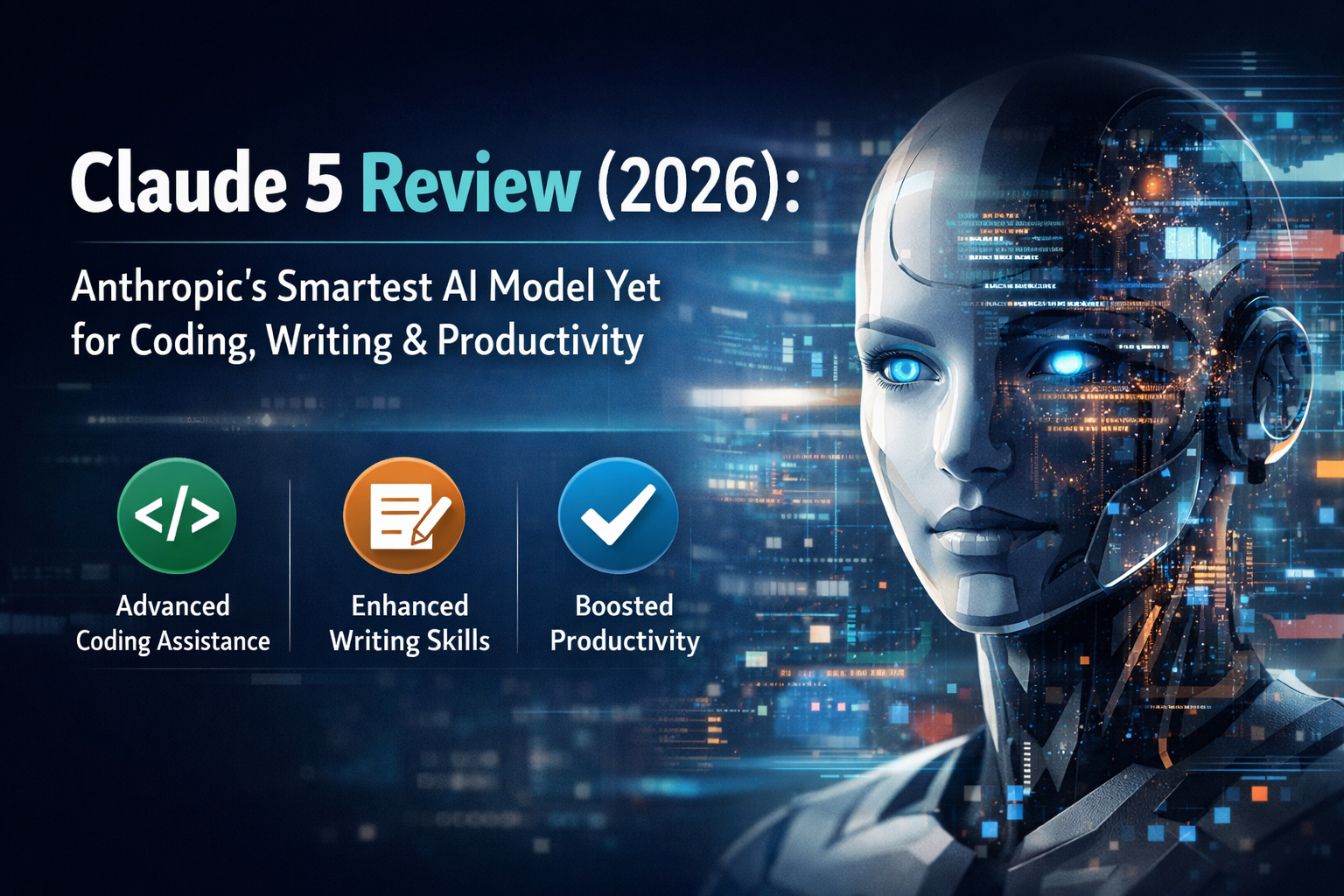
In this ongoing AI race, one of the most closely watched developments is Claude 5, the anticipated next-generation model from Anthropic — the research-focused company behind the Claude family of AI assistants. After the success of Claude Opus 4.5, expectations for Claude 5 are high: more advanced reasoning, a much larger context window, improved multimodal capabilities, and enhanced safety mechanisms that balance performance with ethical alignment.
This article breaks down what we can realistically expect from Claude 5, where it fits in the broader AI ecosystem, its potential use cases, limitations, and why its launch could be a defining moment for AI in 2026.

Why Claude 5 Matters (More Than Just a Version Number)
Claude has always positioned itself differently from many other AI models — it emphasizes usefulness, alignment, and safety by design. While some competitors chase headline benchmarks or flashy demos, Anthropic’s philosophy (often referred to as Constitutional AI) focuses on embedding safety and ethical considerations directly into the model’s reasoning mechanisms.
The result has been models that tend to produce more predictable and reliable outputs — particularly in technical, professional, or regulated contexts.
Claude 5 is expected to be more than just “Claude 4 with better numbers.” Analysts and industry trackers believe it will be a step towards AI that genuinely supports multi-stage workflows, long-term reasoning, and complex real-world problem solving — traits that go beyond traditional chatbot capabilities and into the territory of workflow intelligence.
This matters because the future of AI isn’t about conversation alone — it’s about AI that can think, remember, and contribute meaningfully on complex tasks over extended periods.
What We Expect from Claude 5
Based on credible feature predictions and patterns from prior model releases, here’s a breakdown of what Claude 5 will likely bring to the table.
Enhanced Reasoning and Context Depth
One of the biggest upgrades expected in Claude 5 is deepened reasoning capability. Where previous models could follow logical steps, Claude 5 is predicted to:
- support richer multi-step reasoning
- correct errors within its own output (self-revision)
- explore multiple solution paths before settling on a conclusion
- assign confidence scores to parts of its answers indicating how certain it is
These improvements mean Claude 5 should perform better on complex analytical tasks — such as debugging sprawling codebases, generating detailed research briefs, or solving layered logical problems — with less prompting and fewer follow-ups.
This shift moves Claude away from ”just generating responses” to “reasoning thoughtfully and consistently.”
Massive Context Window Expansion
Another game-changing expectation for Claude 5 is its context window — the maximum amount of text and input it can consider at once.
While Claude 3–4 models have operated with around 200,000 tokens, predictions indicate Claude 5 could support 500,000 to 1 million tokens of context.
Why this matters?
- Entire books or long legal documents can be digested in one session
- Full project files (like large codebases) can be analyzed together
- Long multi-day conversations can remain cohesive without repetition
For professionals, this means less context loss, fewer fragmentation issues, and more meaningful continuity in AI interaction — a crucial advancement for serious tasks.
Domain-Level Coding and Debugging Support
Claude models have long been respected for their coding capabilities, and 4.5 already pushed boundaries with advanced debugging and code reasoning. Claude 5 is expected to take this further, targeting dramatic improvements in benchmarks and real-world software workflows. Predicted coding enhancements include:
- Multi-repository analysis: Ability to understand relationships across connected codebases
- Runtime debugging: Interpreting stack traces and proposing runtime fixes
- Test suite generation: Auto-generation of thoughtful, extensive test coverage
- Higher benchmark scores: Targeting 85%+ on SWE-bench and other relevant metrics
These features will not just make code generation easier — they’ll help developers trust the model as a partner in software design, testing, and maintenance.
Multimodal Evolution and Screen Understanding
While previous Claude versions were strong at text and some vision tasks, Claude 5 is rumoured to push into richer multimodal understanding, potentially including:
- video comprehension
- diagram and chart interpretation
- UI/UX screenshot analysis
- real-time screen or live camera feeds (enterprise-oriented)
This level of multimodality could transform how professionals interact with AI — no longer limited to typed or pasted prompts, but incorporating captured visuals and live context.
Imagine an AI that can review whole design documents, watch video walkthroughs, and synthesize key action items, all in one conversation.
Memory, Persistence & Personalization
One of the most requested features for AI across industries is memory — the ability for a model to remember user preferences, project details, or ongoing context across sessions.
Although Claude 4 and earlier models have implemented memory features for certain users and plans, Claude 5 is expected to refine and expand this capability. Predictions include:
- session persistence: long-term project context retention
- personal preference learning: customization of communication style
- knowledge consolidation: ability to recall past details accurately and meaningfully
This would turn AI from a one-off tool into a long-term collaborator.
Safety, Alignment & Enterprise Controls
Anthropic has always emphasized AI safety and ethical alignment over pure raw performance. Claude 5 is expected to continue this trend with enhanced safety systems such as:
- deeper Constitutional AI 2.0 alignment frameworks
- clearer explanation of limitations and reasoning traces
- enterprise safety policies and compliance features
- customized safety configurations for business use
In many enterprise settings — legal, healthcare, financial services — predictable and explainable AI behavior is more valuable than high Creative output.
Expected Release Timeline
While Anthropic hasn’t announced an official release date, industry tracker sites and pattern analysis suggest Claude 5 could become available between Q2 and Q3 of 2026.
This timing aligns with the company’s historical version cadence, allowing ample time for thorough testing and safety alignment before public rollout. The roadmap looks like:
- Internal testing: underway now
- Beta phase: Q2 2026
- Public availability: Q2–Q3 2026
This predictable timeline helps businesses, developers, and researchers plan their AI integration strategies well in advance.
How Claude 5 Fits Into the Broader AI Landscape
Several major frontier models are competing for dominance in 2026 — from OpenAI’s GPT series to Google’s Gemini. So where does Claude 5 fit?
Strength in Reasoned Reliability
Unlike some models that prioritize velocity of output or raw breadth of data, Claude’s emphasis on structured reasoning, ethical alignment, and detailed responses gives it an edge for professional correctness and trust.
Context and Continuity Advantage
With a predicted context window reaching up to 1 million tokens, Claude 5 is positioned to rival or even surpass other advanced models in long-document and project-level tasks.
Enterprise-Focused Capabilities
Claude’s safety and alignment features make it particularly attractive for regulated industries — legal, healthcare, government, and internal corporate workflows — where AI answers must be explainable, audited, and aligned with compliance standards.
Limitations and Realistic Expectations
No AI model, no matter how advanced, is without limitations.
Internet Access and Live Data
Live, real-time access to up-to-the second internet data isn’t expected to be part of Claude 5 initially, due to safety and cost concerns.
Persistent Autonomous Learning
While memory features may improve, fully autonomous learning without explicit user prompts is unlikely due to privacy and architecture constraints.
Tradeoff Between Speed and Depth
Sometimes deeper reasoning can come at the cost of slower response times — especially if the model is parsing massive context windows.
Real-World Use Cases for Claude 5
Here’s how Claude 5 could change workflows in practice:
Product Development & Coding
Imagine asking Claude 5 to analyze a whole codebase for architectural issues, generate comprehensive test suites, debug logic across multiple repositories and propose design patterns based on current best practices
This goes beyond simple snippet generation into trusted engineering intelligence.
Strategic Business & Research Intelligence
Strong reasoning and large context handling make Claude 5 ideal for summarizing market research reports, generating strategic insights from large data collections, preparing compliance briefs or policy analysis and extracting actionable recommendations from meetings
Education & Knowledge Work
Students and professionals alike benefit from deep academic material understanding, project context persistence across sessions and long-document summarization without losing nuance
This changes how knowledge workflows scale.
Final Thoughts
Claude 5 isn’t being designed simply to answer questions faster or better — it’s being crafted to think with you. Its anticipated improvements in reasoning, multimodal understanding, context depth, and safety alignment position it as one of the most relevant AI models for real-world professional use in 2026.
Whether you’re a developer, business decision-maker, researcher, or enthusiast, Claude 5 represents a meaningful evolution in what AI can do — not just what it can say.
While we wait for the official release, preparing workflows around these expectations can give you a significant advantage when it arrives.