
Artificial intelligence has reached an interesting point. We no longer get impressed just because a chatbot can write poems or answer questions. That phase is over. Today, the real question is much simpler: does this AI actually make daily work easier, or is it just a fancy demo?
Most AI tools still fall into the second category. They look impressive during presentations, but in everyday life, they feel separate from how we normally work. You open a chatbot tab, ask something, copy the result, paste it somewhere else, and repeat the process. Helpful, yes — but still disconnected.
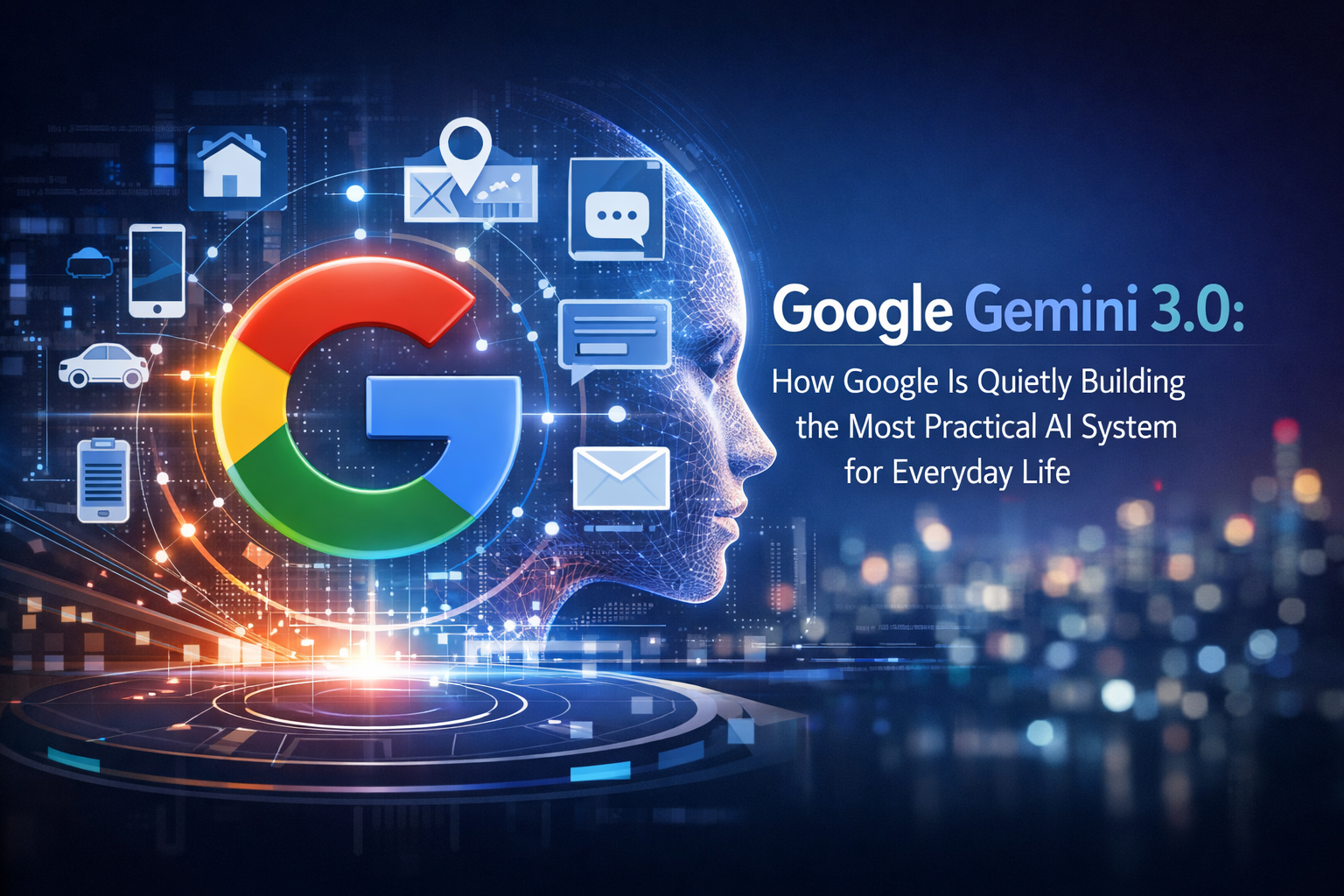
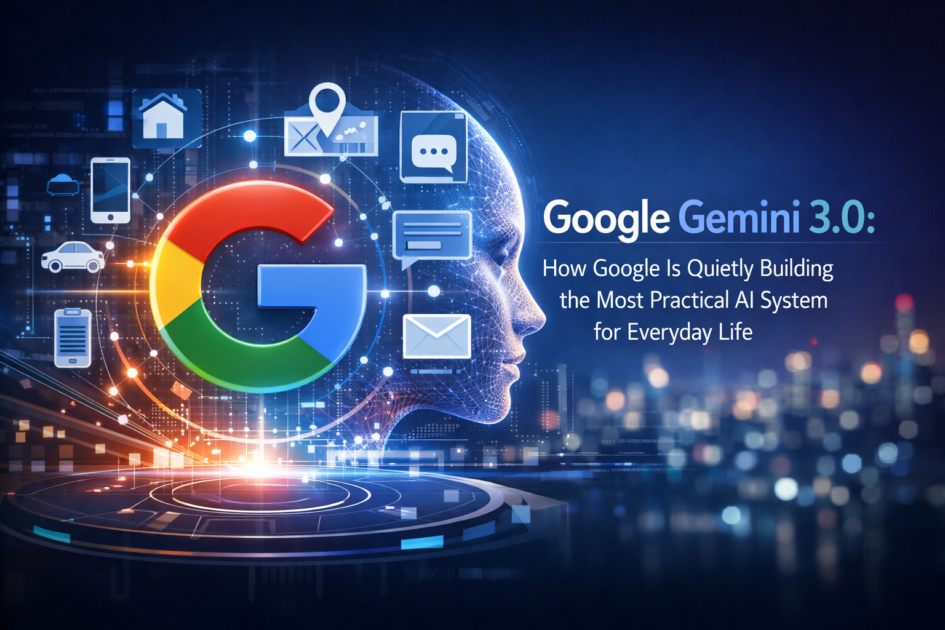
Google seems to understand this problem better than most companies. Instead of creating another flashy chatbot, Google is taking a quieter, more practical route. It is embedding AI directly into the tools billions of people already use — Search, Chrome, Gmail, Docs, Android, and cloud platforms.

The intelligence powering this shift is Gemini 3.0. And unlike many AI launches that create noise for a few weeks and disappear, Gemini feels different. It isn’t trying to replace your workflow. It’s trying to disappear into it. That difference may sound small, but it fundamentally changes how useful AI becomes in real life.
Understanding Gemini 3.0 Beyond the Hype
At its core, Gemini 3.0 is Google’s most advanced large language model, designed with multimodal capabilities and stronger reasoning. But calling it just another “AI model” would be misleading.
Gemini is not meant to be used like a chatbot you occasionally visit. It is designed as an intelligence layer that sits underneath multiple Google products.
Think of it less like an app and more like infrastructure. Just like you don’t “open the internet” anymore — it’s simply there — Google wants Gemini to work the same way. Always present. Always assisting. Rarely visible. This design philosophy is what separates Gemini from tools like ChatGPT or Claude. Those tools feel like destinations. Gemini feels like an enhancement to everything you already do.
From Text AI to Multimodal Intelligence
One of the biggest technical changes in Gemini 3.0 is its multimodal nature. Earlier AI systems mostly understood text. You typed something, and they responded in text. That’s it.
Gemini expands that understanding to multiple forms of information at the same time. It can read documents, interpret images, understand screenshots, analyze charts, and combine these inputs with written instructions. In practice, this means you can show instead of explain.
Instead of describing a complicated graph, you upload it. Instead of summarizing a 50-page PDF manually, you ask Gemini to extract insights.
Instead of typing notes, you can convert messy material into structured content. This may not sound dramatic, but in daily work it saves an enormous amount of time. And time is where real value lies.
The Real Power: Integration, Not Intelligence
Here’s something many people miss. Raw intelligence alone doesn’t guarantee usefulness. Integration does. You might have the smartest AI in the world, but if it lives in a separate app, most people won’t use it consistently.
Google’s biggest advantage isn’t that Gemini is smarter than every competitor. It’s that Google controls:
- Search
- Chrome
- Android
- Gmail
- Docs
- Workspace
- Cloud infrastructure
That ecosystem gives Gemini something others can’t easily copy — distribution.
When Gemini improves Search, billions of people benefit instantly. When Gemini enhances Chrome, it affects everyday browsing. When it assists inside Gmail or Docs, office work becomes faster automatically. No extra setup required.
This quiet integration makes Gemini feel less like “AI software” and more like a natural evolution of the tools themselves.
How Gemini Changes Everyday Workflows
To understand Gemini’s impact, it helps to look at ordinary situations rather than technical benchmarks. Imagine researching a topic.
Earlier, you might open ten tabs, read multiple articles, compare information, and manually piece together conclusions.
Now, Search provides structured AI summaries at the top. You start with a clear overview, then dive deeper only when necessary. The mental effort drops significantly. Or consider writing.
Instead of staring at a blank page, you generate outlines, refine drafts, summarize notes, and polish language with assistance built directly into the editor. You’re no longer starting from zero. You’re iterating faster. Even browsing feels different.
With AI assistance inside Chrome, repetitive actions like comparing products, filling details, or collecting information can be automated. It’s less clicking, more thinking. And that’s exactly how technology should work — removing friction rather than adding complexity.
Where Gemini 3.0 Truly Shines
After observing how Gemini behaves across products, one thing becomes clear: it isn’t built for entertainment. It’s built for productivity. It works best when handling serious tasks:
- research
- analysis
- writing
- coding
- planning
- decision-making
Its reasoning is noticeably stronger than earlier Google assistants. It can follow longer context, break problems into steps, and provide explanations instead of surface-level answers.
- For students, this means faster understanding.
- For bloggers, faster research.
- For developers, quicker debugging.
- For professionals, fewer repetitive tasks.
In each case, the benefit isn’t “wow.” It’s “this saved me 30 minutes.” And honestly, that’s far more valuable.
The Limitations Nobody Should Ignore
Of course, no AI system is perfect. Gemini still makes mistakes. Sometimes it overconfidently presents incorrect information. Some advanced capabilities depend on premium tiers. And like all large models, it occasionally misunderstands nuance.
Blind trust would be a mistake. But used correctly — as an assistant rather than an authority — it becomes extremely effective. The goal isn’t to replace thinking. It’s to reduce busywork.
Why Gemini Matters More Than It Seems
Many AI releases create headlines and disappear. Gemini feels quieter, but more fundamental. It represents a shift from “AI as a product” to “AI as infrastructure.”
Instead of opening AI when you need it, AI becomes part of everything you do. That subtle change might define the next decade of computing. And because Google already sits at the center of the internet for billions of users, Gemini has a realistic chance of becoming the most widely used AI system in the world — almost by default. Not because people choose it. But because it’s simply there.
Final Thoughts
If you’re watching the AI space seriously, Gemini 3.0 isn’t just another model update. It’s a strategic move. Google isn’t chasing hype. It’s building habit. And habits win.
By embedding AI into everyday tools, Gemini quietly becomes useful without demanding attention. Over time, that practicality may matter more than any flashy demo or viral feature. In the end, the most successful technology is rarely the loudest. It’s the one you stop noticing — because it just works. Gemini 3.0 feels exactly like that.