NVIDIA Nemotron 3 Super: What Makes NVIDIA’s New 120B AI Model Different?
Quick Summary
NVIDIA Nemotron 3 Super is an open-weight AI model built for a type of workload that is…
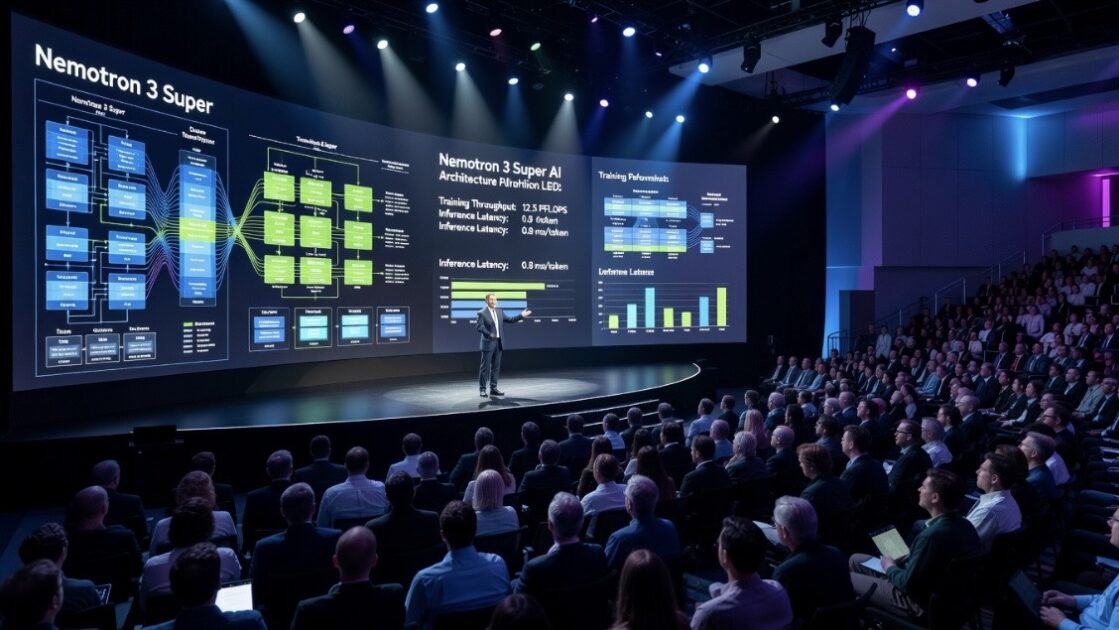

NVIDIA Nemotron 3 Super is an open-weight AI model built for a type of workload that is becoming increasingly important: agentic AI. Instead of focusing only on generating answers, the model is designed to handle long-context reasoning, coding, tool use, multi-step tasks, and high-throughput AI workloads where both intelligence and efficiency matter.
NVIDIA launched Nemotron 3 Super on March 11, 2026, as part of its Nemotron 3 family. What makes the model particularly interesting is not simply its 120 billion total parameters, but how those parameters are used. Only around 12 billion parameters are active during inference, allowing the model to deliver the capabilities of a much larger system while avoiding the cost of activating the entire model for every token.
Under the hood, Nemotron 3 Super combines LatentMixture-of-Experts (LatentMoE), Mamba-2, attention, and Multi-Token Prediction into a hybrid architecture. This design is aimed at improving the balance between reasoning capability, long-context performance, and inference efficiency.
AI Flowchart Generator from Text: Convert Meeting Notes into Diagrams Instantly
Read StoryThe model also supports a context window of up to 1 million tokens, making it particularly relevant for large codebases, extensive documents, research workflows, retrieval-augmented generation (RAG), and AI agents that need to work through large amounts of information in a single task.
But the specifications alone do not explain why Nemotron 3 Super is attracting attention. Its more important story is how NVIDIA’s architecture choices affect AI agent performance, coding, inference speed, scalability, and the practical cost of running large AI models.
So, what exactly is NVIDIA Nemotron 3 Super, how does its LatentMoE architecture work, what can the model actually be used for, and how does it compare with other open AI models? This guide breaks down the model, its architecture, capabilities, availability, and real-world use cases in simple terms.
What Is NVIDIA Nemotron 3 Super?
Nemotron 3 Super is a large language model built by NVIDIA for applications where AI needs to reason through complex tasks rather than simply answer individual questions. Its primary focus is agentic AI that includes systems that can break a problem into multiple steps, use external tools, maintain information across long workflows and complete tasks with less human intervention.
The model has 120 billion total parameters, but only around 12 billion parameters are active at inference time. This distinction is important because the total parameter count gives an idea of the model’s overall capacity, while the active parameter count has a much greater effect on how much computation is required for each generated token.
Nemotron 3 Super also supports a context window of up to 1 million tokens that gives developers the ability to provide extremely large amounts of information to a single workflow, which is particularly useful for software repositories, long documents, research material, enterprise records and multi-step agent tasks.
NVIDIA positions the model around three major requirements for modern AI agents: reasoning capability, long-context understanding and efficient inference.
Why NVIDIA Uses a Hybrid Mamba-Transformer Architecture
One of the most interesting aspects of Nemotron 3 Super is its architecture. Rather than relying entirely on the traditional Transformer design, NVIDIA combines Mamba-2 layers, Mixture-of-Experts layers and selected attention layers. This hybrid approach is intended to combine the strengths of different architectures instead of forcing one architecture to handle every part of the workload.
Transformers remain extremely effective for tasks that require sophisticated reasoning and attention across information. Mamba-style architectures, meanwhile, can offer advantages in memory and computational efficiency when processing long sequences.
Nemotron 3 Super brings these ideas together. NVIDIA says its Mamba layers provide substantially improved memory and compute efficiency, while Transformer components contribute to the reasoning capabilities needed by demanding AI workloads.
The result is not simply a larger model. It is an attempt to make a large model practical for workloads where inference speed and operating cost matter.
LatentMoE Is the Model’s Most Interesting Trick
One of the more interesting parts of Nemotron 3 Super is the way NVIDIA has changed the usual Mixture-of-Experts approach. To understand that difference, it helps to look at what normally happens inside an MoE model.
In a traditional Mixture-of-Experts system, the incoming tokens are sent to a router, which decides which specialist experts should handle them. Those experts then work on the original token representations. This works well, but processing the full input can become expensive as models and their context windows get larger.
Nemotron 3 Super takes another route with LatentMoE. Instead of sending the raw tokens straight to the experts, the model first compresses the information into a smaller representation. That compressed version is then passed through the routing system, which determines which experts should work on it.
A simple analogy is sending a complicated request inside a large company. Rather than forwarding a long email containing every single detail to several departments, the important information can first be condensed into a useful summary. That summary is enough for the right department to understand what needs to be done without having to process the entire original message.
The same basic idea is being applied here. The experts receive a more compact representation instead of the complete input, which reduces the amount of information they have to process. According to NVIDIA, this allows Nemotron 3 Super to use up to four times more experts for roughly the same computational cost.
That has an important implication for a model designed around sparse computation. The model therefore doesn’t need to run every parameter for every piece of information it receives. LatentMoE helps make the specialist side of that system more efficient, giving the router more experts to choose from without increasing the computational burden in the same proportion.
For practical workloads, that balance can be valuable. A coding request, a reasoning problem and a long agentic task do not necessarily require the same kind of processing. Having a larger pool of specialists gives the routing system more choices, while the compressed representations help keep that process manageable.
This is why LatentMoE is more than just another technical name attached to Nemotron 3 Super. It is one of the architectural decisions NVIDIA is using to pursue a difficult combination: more specialist capacity without paying the full computational cost of activating everything. For applications such as coding agents, long-context reasoning and other workloads that may involve many requests, that efficiency can have a direct impact on inference speed and the amount of hardware needed to run the model.
A 1 Million Token Context Window Changes What Agents Can Handle
Long context is another major reason Nemotron 3 Super is aimed at agentic workloads. The model supports up to 1 million tokens of context. NVIDIA’s testing includes long-context scenarios rather than relying only on short prompts, and its model information reports strong performance at very large context lengths.
This can matter considerably when an AI agent needs to retain a large amount of information during a task. For example, a software development agent could potentially work with a substantial codebase in one context instead of repeatedly breaking the repository into smaller pieces. A research system could process large collections of reports and documents while maintaining more of the surrounding information. Enterprise applications could similarly use long context for records, tickets, documentation and other large datasets.
NVIDIA specifically highlights software development, financial analysis and other agentic workloads where maintaining large amounts of workflow information can reduce the need to repeatedly reconstruct context.
A million-token context window does not mean every application should simply feed a million tokens into the model. Long context still consumes computational and memory resources. Its real value is that developers have the option when their application actually requires it.
Multi-Token Prediction Adds Another Layer of Speed
Nemotron 3 Super also incorporates Multi-Token Prediction (MTP). Instead of limiting prediction to the next token in the conventional manner, MTP allows the model to predict multiple future tokens, which can then be used by the inference system to accelerate generation. NVIDIA says this contributes to faster inference and reports up to 3x faster inference from multi-token prediction in its architecture discussion.
This becomes particularly relevant when an AI system has to generate large amounts of code, reasoning or tool-related output. Even small improvements in token generation speed can become significant when multiplied across many users and long-running agents.
Nemotron 3 Super Focuses on Efficiency as Much as Intelligence
One of the more useful ways to evaluate Nemotron 3 Super is to look beyond benchmark intelligence alone. For an AI agent, generating an accurate answer is only part of the equation. The system may need to generate thousands or millions of tokens while multiple users interact with it simultaneously. That makes throughput extremely important.
NVIDIA reports that Nemotron 3 Super can achieve up to 5x higher throughput than the previous Nemotron Super model in the company’s comparisons. NVIDIA also reports up to 2.2x the inference throughput of GPT-OSS-120B and 7.5x that of Qwen 3.5-122B under a specified 8K-input/64K-output configuration. These are NVIDIA’s reported measurements, so they should be understood as benchmark results under particular hardware and testing conditions rather than universal performance guarantees.
That distinction matters because real-world performance depends on hardware, quantization, context length, batch size, serving software and workload. Still, the overall direction is clear: NVIDIA is trying to make Nemotron 3 Super efficient enough to serve high-volume agentic workloads rather than treating speed as an afterthought.
How Open Is Nemotron 3 Super?
The word “open” is often used loosely in the AI industry, but there are different levels of openness. Some models provide downloadable weights but restrict commercial usage. Others may provide weights while keeping training information private. Some allow fine-tuning, while others are primarily accessible through hosted APIs.
NVIDIA’s Nemotron approach is considerably more open than a simple API-only model. NVIDIA is releasing pre-trained, post-trained and quantized checkpoints, along with training datasets and model recipes. The company also provides information about the training methodology and resources for researchers and developers who want to understand or modify the model.
The model is distributed under the NVIDIA Nemotron Open Model License, and NVIDIA describes it as an open model that can be deployed and customized on workstations, data centers or cloud infrastructure. That makes Nemotron 3 Super more interesting for organizations that want control over where their AI system runs rather than relying entirely on a third-party hosted service.
What Can Nemotron 3 Super Be Used For?
The model’s design makes it particularly relevant to applications where multiple steps, long context or tool use are involved. Software development is one obvious example. An AI coding agent can use the model to understand large codebases, generate code, investigate bugs and work through multi-step programming tasks.
Research is another strong use case. A system handling thousands of pages of material can benefit from a large context window, particularly when information from different sections needs to remain available during reasoning.
The model can also be used for RAG systems, chatbots, tool-using agents, IT automation and collaborative multi-agent systems. NVIDIA’s model card specifically identifies agentic workflows, long-context reasoning, high-volume workloads, tool use and retrieval-augmented generation among its intended use cases.
NVIDIA also highlights scenarios such as financial analysis, where an agent may need to work through large collections of reports, and cybersecurity workflows where reliable tool calling can be important. This is why Nemotron 3 Super is better understood as an infrastructure-oriented AI model rather than simply another chatbot.
Where Can Nemotron 3 Super Be Accessed?
Developers do not necessarily have to download and host the model themselves. NVIDIA makes Nemotron 3 Super available through NVIDIA’s model platform, Hugging Face and other infrastructure providers, while services such as Perplexity and OpenRouter provide hosted access. NVIDIA has also highlighted integrations with developer tools and enterprise platforms.
The model is available in different deployment formats, including quantized versions designed to reduce hardware requirements. For developers interested in local or private deployment, NVIDIA says Nemotron 3 Super can run on NVIDIA infrastructure ranging from systems such as DGX Spark to larger data-center configurations.
The official model card lists 8× H100 80GB as the minimum GPU requirement for its standard deployment configuration, although hardware requirements vary depending on the model format and serving setup. That last point is important: downloading an open model does not automatically mean it will run comfortably on a typical consumer laptop or gaming PC.
Nemotron 3 Super and Coding Agents
Coding is one area where the model’s architecture becomes especially relevant. Modern coding agents are not limited to generating a few lines of code. They may need to inspect an entire repository, understand dependencies, modify several files, run tools, analyze errors and continue working through multiple stages.
Nemotron 3 Super is designed for exactly this type of workflow. NVIDIA says the model excels at coding when paired with a frontier planner and can follow detailed specifications while executing multi-step coding tasks.
The model has also been integrated into coding-oriented products and services. NVIDIA identifies tools and platforms such as CodeRabbit, Factory and Greptile among the systems incorporating Nemotron 3 Super, while Perplexity has used it in search and its Computer system.
For developers, this is arguably more meaningful than a single benchmark score because it shows how the model is being positioned inside real agentic workflows.
How Does It Compare With Other Open Models?
Nemotron 3 Super competes in a rapidly changing segment of large open and open-weight models. NVIDIA reports that it performs strongly against models including GPT-OSS-120B, GLM 4.7 Flash and Qwen3-class models, particularly when efficiency and throughput are considered alongside intelligence.
The comparison should not be reduced to the question of which model has the highest benchmark score. A model that produces excellent results but requires substantially more compute may not be the best choice for a high-volume application. Conversely, a highly efficient model may not be suitable if a particular workload demands maximum reasoning quality.
Nemotron 3 Super’s appeal is therefore its combination of intelligence, throughput, long context and openness. NVIDIA’s published results indicate that the model can outperform or match several competing models in selected evaluations while requiring less active computation. Again, these results come from NVIDIA’s testing methodology and should be independently evaluated for a specific production workload before making an infrastructure decision.
Why Nemotron 3 Super Matters
Nemotron 3 Super is not important simply because NVIDIA released another 120-billion-parameter model. Its significance comes from the direction NVIDIA is taking with model architecture.
The combination of LatentMoE, Mamba-2, Transformer attention, Multi-Token Prediction, long-context support and low active parameter usage reflects a broader shift in AI development. The goal is increasingly to build models that can perform complex work continuously without requiring an enormous amount of computation for every single token. That matters for AI agents in particular.
An agent may spend far more time interacting with tools, reading documents, revisiting previous steps and generating intermediate reasoning than a conventional chatbot does. NVIDIA says multi-agent systems can generate dramatically more tokens than standard conversational interactions, making efficiency a fundamental part of the problem rather than a minor optimization. Nemotron 3 Super is designed around that reality.
Verdict
NVIDIA Nemotron 3 Super is a serious open model aimed at the next stage of AI development, where agents need to reason across long workflows while remaining fast enough to operate at scale.
Its 120 billion total parameters and 12 billion active parameters, 1 million-token context window, hybrid Mamba-Transformer architecture, LatentMoE routing and Multi-Token Prediction make it considerably more interesting than a conventional large language model.
The model’s openness is another major advantage. Developers can access weights, datasets and training recipes rather than being restricted to a single hosted interface. That creates opportunities for self-hosting, fine-tuning, research and commercial development under NVIDIA’s licensing terms.
Nemotron 3 Super will not automatically be the best choice for every AI application. Hardware requirements, serving infrastructure, latency, licensing, workload characteristics and actual benchmark performance should all be considered before deployment.
For developers building AI agents, coding assistants, long-context research systems, RAG applications or high-volume enterprise automation, however, Nemotron 3 Super is one of the more notable open models released in 2026.
And that is ultimately what makes the model worth paying attention to: NVIDIA is not simply trying to make AI models larger. With Nemotron 3 Super, the focus is increasingly on making large-scale intelligence more efficient, more deployable and more useful for systems that have to do real work.
Share this article
Related Articles
Continue reading similar stories.


Trending Now
Popular articles readers are exploring.

Xiaomi 17 Pro Review – The New Flagship Evolution

Lenovo Legion Pro 7i Review 2026 – The Ultimate Gaming & Creator Laptop

Vivo X200 FE Full Review in 2026: Price, Camera, Features & Performance

iPhone 17 Air Full Review: Price, Camera, Battery & Features